

For centuries, literature has been shaped by the voices that were allowed to speak—and just as importantly, by those that were silenced. Women’s writing emerges from this history not merely as a literary category, but as a powerful act of reclaiming space, identity, and agency. It is not simply about women putting pen to paper; it is about writing that actively challenges, questions, and reshapes how gender itself is understood.
Traditionally, the literary world was dominated by male perspectives, where women often appeared as characters confined within narrow roles—muses, caretakers, or symbols of virtue and sacrifice.
However, when women began to write their own stories, a profound shift occurred. These narratives moved beyond stereotypes and entered the realm of lived experience, revealing the complexities of identity, emotion, and struggle.
Virginia Woolf famously wrote, “A woman must have money and a room of her own if she is to write fiction.” Her words underline the vital importance of freedom, independence, and creative space for women writers.
Intersectionality and Identity
At its core, women’s writing explores the intersection of gender with other aspects of identity such as class, culture, race, and sexuality. It questions: What does it mean to be a woman in a world structured by inequality? How do societal expectations shape personal choices? And how can language itself become a tool for liberation?
Simone de Beauvoir captured this idea when she stated, “One is not born, but rather becomes, a woman.” Through poetry, fiction, memoirs, and essays, women writers articulate both personal and collective experiences, often turning the ordinary into something profoundly political.

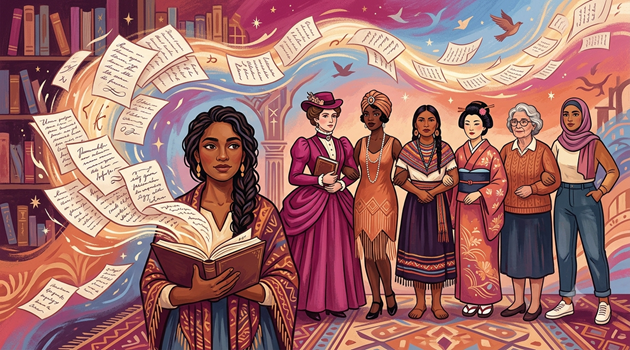
Importantly, women’s writing is not monolithic. It does not represent a single voice or a uniform experience.
The concerns of a woman in a rural setting may differ greatly from those of someone in an urban environment; similarly, historical contexts shape narratives in unique ways. This diversity enriches literature, offering multiple perspectives that challenge any one-dimensional understanding of gender. Writers such as Jane Austen, Ismat Chughtai, and Toni Morrison brought forward voices that questioned social norms and highlighted women’s realities across different cultural contexts.
The Contemporary Landscape
In contemporary times, women’s writing continues to evolve, embracing new themes and forms. It addresses urgent issues such as body autonomy, mental health, gender fluidity, and the redefinition of traditional roles.
Social media and digital platforms have further expanded the reach of these voices, allowing more women to share their stories and connect with wider global audiences.
Expression as Empowerment
Maya Angelou beautifully expressed the power of storytelling when she said, “There is no greater agony than bearing an untold story inside you.”
However, the journey is far from complete. Gender biases still exist within publishing, criticism, and readership. Women writers often face challenges in being taken seriously or in having their work recognized on equal footing with their male peers.
Yet, each story written and shared contributes to breaking these barriers, gradually reshaping the literary landscape. Chimamanda Ngozi Adichie warns against stereotypes through her concept of “the danger of a single story,” reminding readers of the constant need for diverse and authentic female voices.
Redefining the Future
Ultimately, women’s writing is about visibility. It is about making space for voices that were once unheard and ensuring they are no longer overlooked. It invites readers to engage with experiences different from their own, fostering empathy and deep understanding. In doing so, it not only transforms literature but also challenges society to become more inclusive and equitable.
As we read and celebrate women’s writing, we participate in this ongoing dialogue—one that continues to redefine gender, expand possibilities, and affirm the power of storytelling as a true force for change.

