

Sanjay Kumar and Shruti
At first glance, Bodh Gaya appears like many other towns in Bihar: modest streets, small shops, tea stalls filled with conversation, and the rhythm of everyday life unfolding at its own pace. Yet beneath this quiet surface lies a place whose historical and cultural significance extends far beyond its geographical scale.

Bodh Gaya represents a remarkable intersection of history, art, architecture, and international exchange where a small Indian town continues to hold a unique place in the global imagination.
A Quiet Town, An Extraordinary Legacy
The roots of Bodh Gaya’s significance stretch back to the third century BCE, when the Mauryan emperor Ashoka visited the site and commissioned structures marking the location associated with the enlightenment of Gautama Buddha. Ashoka’s patronage ensured that the memory of the place became embedded in architecture and pilgrimage routes across Asia. Over centuries, Bodh Gaya became part of a network of travel and intellectual exchange linking India with Sri Lanka, Southeast Asia, Tibet, and beyond.
From Ashoka to Asia: A Pilgrimage Network Born in Stone
Its landscape reveals something deeper: the making of a multicultural and multinational society expressed through architecture, paintings, and sculpture. Walking through the town today feels like moving across different parts of Asia within a few kilometres. Monasteries built by Sri Lanka, Myanmar, Thailand, Japan, Bhutan, and Vietnam stand alongside each other, each carrying distinct architectural styles and artistic traditions. Rooflines curve in different ways, murals depict varied visual narratives, and statues follow unique aesthetic conventions. Together they create a living museum of Asian artistic exchange.
A Living Museum of Asian Architecture and Exchange
These structures also illustrate a second important dimension of Bodh Gaya’s global character: multi-country participation. The establishment of the first Sri Lankan monastery here in 1872 marked the beginning of a modern phase in which Buddhist communities from different countries began to invest in the site again. Over the decades, governments, cultural organisations, and monastic communities across Asia contributed to the construction of monasteries, educational centres, and cultural institutions. In doing so, Bodh Gaya gently evolved into a space where international presence became embedded in everyday life.
On March 14–15, scholars, diplomats, and policymakers gather at Bihar Museum for the eighth Bodh Gaya Global Dialogues. The event is rooted in a town whose entire history has been one long, unfinished conversation between cultures.
The third dimension lies in the interaction between the ‘self’ and the ‘other.’ Bodh Gaya has historically been a meeting point where local communities and international visitors encountered each other through trade, conversation, and shared spaces. One notable example of this exchange was the Tibet–Lhasa market that developed in the area during the twentieth century, bringing Tibetan traders and artisans into contact with local populations. Such interactions transformed Bodh Gaya into more than a destination; it became a zone of cultural negotiation and exchange.
This dynamic has continued in the decades following India’s independence. As diplomatic relations between India and Southeast Asian countries deepened, Bodh Gaya emerged as an important cultural bridge. Scholars often note that Buddhism functioned as a historical link between India and much of Asia, and Bodh Gaya came to symbolise this shared heritage. In this sense, the town began to act as an informal ambassador of India’s cultural relations with Southeast Asia. Delegations, monks, artists, and tourists arriving from different parts of the world contributed to the town’s growing cosmopolitan identity.
Two Million Visitors, One Contact Zone
In recent years, approximately two million visitors have travelled to Bodh Gaya annually. Some arrive out of curiosity, others as scholars, artists, or travellers interested in its historical and cultural significance. What they encounter is a place where local everyday life coexists with global presence. Small neighbourhoods sit beside international monasteries. Local markets supply goods to pilgrims and tourists from across continents. Languages from across Asia and Europe echo through the same streets.
📍 Event Highlight The 8th Bodh Gaya Global Dialogues | Bihar Museum, Patna | March 14–15, 2026 Bringing together scholars, diplomats, and civil society to explore compassion, interdependence, and ethical responsibility.
Historians often describe such places as ‘contact zones,’ spaces where cultures meet, interact, and reshape each other. Bodh Gaya exemplifies this idea vividly. Its built environment records centuries of cultural exchange, while its contemporary life continues to sustain these interactions.
In many ways, Bodh Gaya demonstrates how a place can remain rooted in its local identity while simultaneously speaking to the wider world. Its history shows how ideas, art, architecture, and people move across borders, leaving traces that accumulate over time. What began as a local site gradually grew into a global cultural landscape.
A Dialogue That Travels Across Time

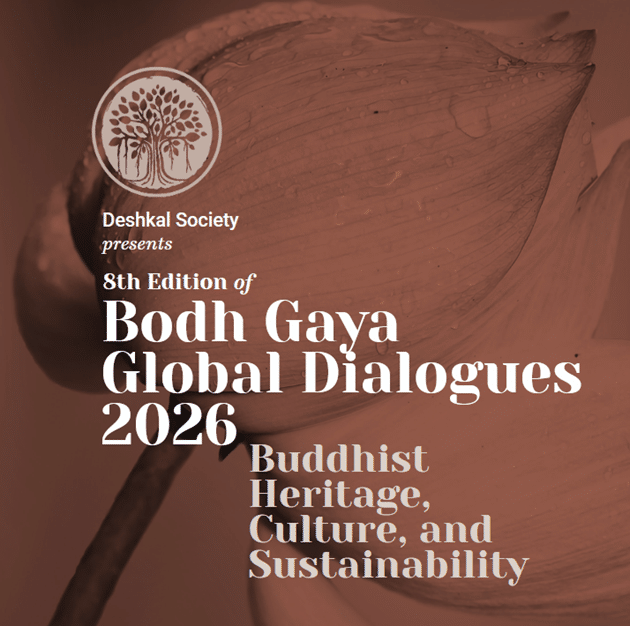
This dialogue between past and present also finds expression in contemporary initiatives such as the Bodh Gaya Global Dialogues, which bring together scholars, diplomats, civil society actors, and policymakers to reflect on the continuing relevance of the values associated with this place: compassion, interdependence, and ethical responsibility. The eighth edition of these dialogues, to be held at the Bihar Museum in Patna on March 14-15, 2026, extends the intellectual geography of Bodh Gaya into new institutional spaces, suggesting that while the idea of Bodh Gaya travels widely, its meaning remains anchored in a long and evolving historical landscape.
This continuing exchange of ideas also explains why the philosophical insights associated with the place continue to resonate across time and cultures. The Four Noble Truths, central to Buddhist thought, speak about the nature of human suffering, its causes, the possibility of its cessation, and the path leading toward that transformation. Beyond religious interpretation, these ideas can also be read as reflections on the human condition—an invitation to observe, understand, and respond to the complexities of life with awareness.
In this sense, Bodh Gaya remains more than a town or a monument. It stands as a reminder that local histories can carry global meanings, and that the meeting of cultures often produces spaces where humanity learns to see itself more clearly.

